Project Sagebrush
An AI-assisted coordination system for a ranch house restoration — schedules, budgets, and next steps, proposed by GPT-4 and never executed without a human decision. Built on Airtable and Notion, under one rule that shaped everything else: AI proposes, I dispose.
Status
Ongoing
Stack
Airtable + Notion + GPT-4
Core rule
AI proposes, I dispose
Type
Coordination System
A restoration project has more moving parts than any one person can hold in their head — budgets, timelines, contractors, and decisions that depend on other decisions. I wanted to know whether AI could organize that chaos into something legible without quietly making decisions I hadn't signed off on. That second half of the question mattered more than the first — plenty of tools will organize a project for you. Very few are built to stop and wait for a yes.
The Core Rule
"AI proposes, I dispose."
Every recommendation the system generates — a schedule, a budget adjustment, a next step — is a suggestion until a human reviews and approves it. Nothing executes on its own. This isn't a safety setting bolted on afterward; it's the architecture the whole system was designed around from day one.
Proposal Engine
GPT-4 drafts schedules, budget breakdowns, and next-step recommendations based on current project state.
Human Approval Gate
Nothing executes automatically. Every recommendation sits as a proposal until it's reviewed and approved.
Airtable Backbone
Budgets, timelines, contractor details, and decision history live in structured, queryable tables.
Notion Coordination Layer
Narrative notes, decisions, and context that don't fit neatly into a database row.
Full Decision Log
Every AI proposal and every human decision on it is recorded — accepted, modified, or rejected.
Human-in-the-Loop by Design
The rule isn't a setting that can be toggled off. It's the architecture the system was built around from day one.
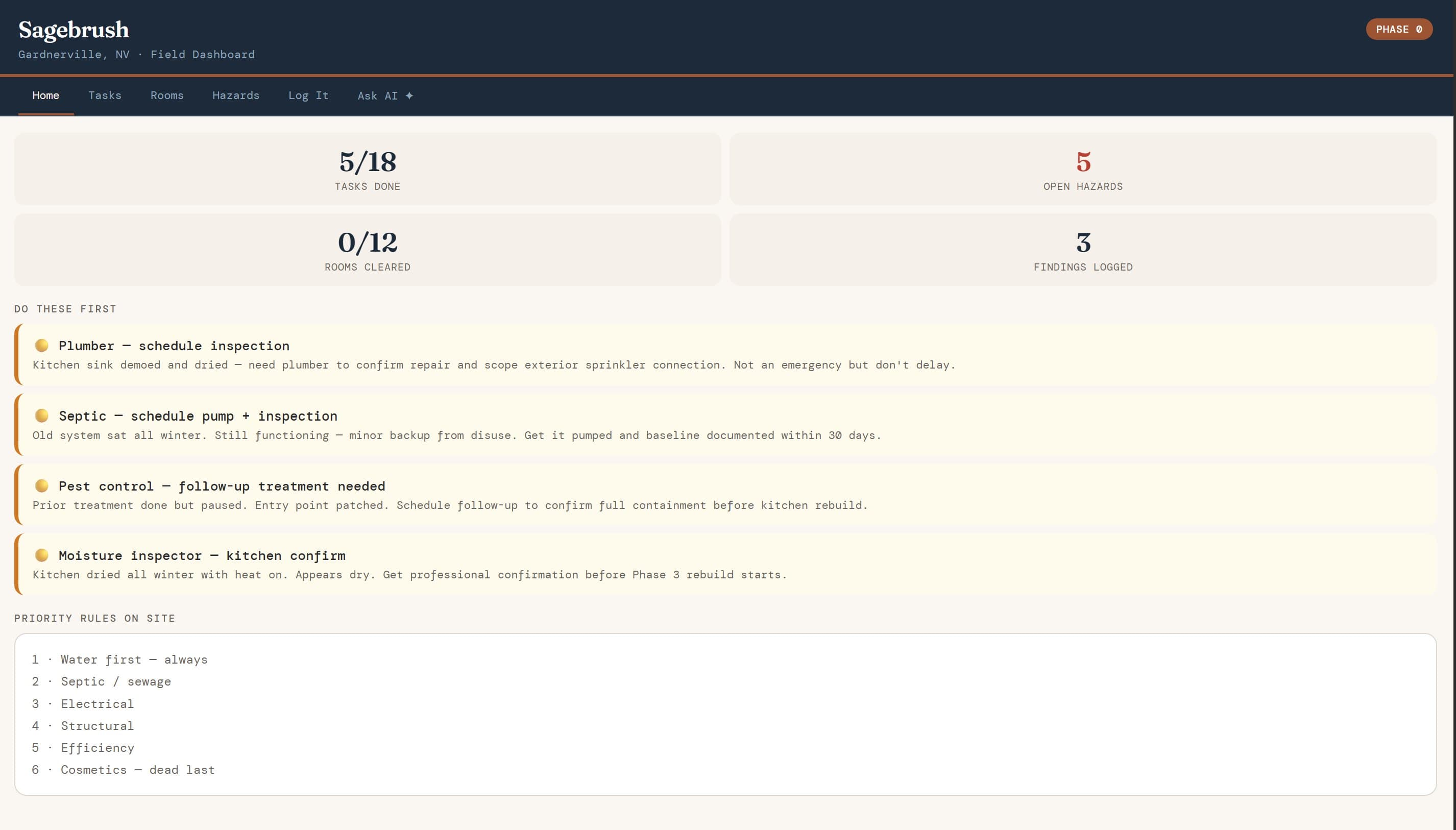
The actual field dashboard — this is what the crew sees on site, not a mockup.
"AI proposes, I dispose" wasn't a nice-to-have.
It's the thing that made the whole system trustworthy enough to actually use. The moment I trust a coordination layer to just act, I've traded a legible bottleneck for an invisible one.
Restoration chaos is a systems problem, not a task-list problem.
Budgets, timelines, and contractor availability are all dependent on each other. A flat to-do list can't represent that. A coordination system that understands dependencies can.
The best AI proposals were the ones I rejected.
A rejected proposal usually meant the system had surfaced a real tradeoff I hadn't consciously weighed yet — even when the recommendation itself was wrong, the question behind it was often right.
This runs on the same principle as everything else on this site.
AI is useful in proportion to how well it stays a thinking partner instead of becoming an unaccountable decision-maker. Sagebrush just makes that principle physical — walls, budgets, and contractors instead of dashboards.
The human-in-the-loop principle running underneath Sagebrush is the same one running underneath the whole AI Throughput framework: AI is useful in proportion to how well it stays a thinking partner instead of becoming an unaccountable decision-maker. Sagebrush just makes that principle physical — walls, budgets, and contractors instead of dashboards.
Disclaimer: This is a personal project. No proprietary employer systems, data, or workflows are represented here — this documents a personal AI coordination system, not professional consulting work.